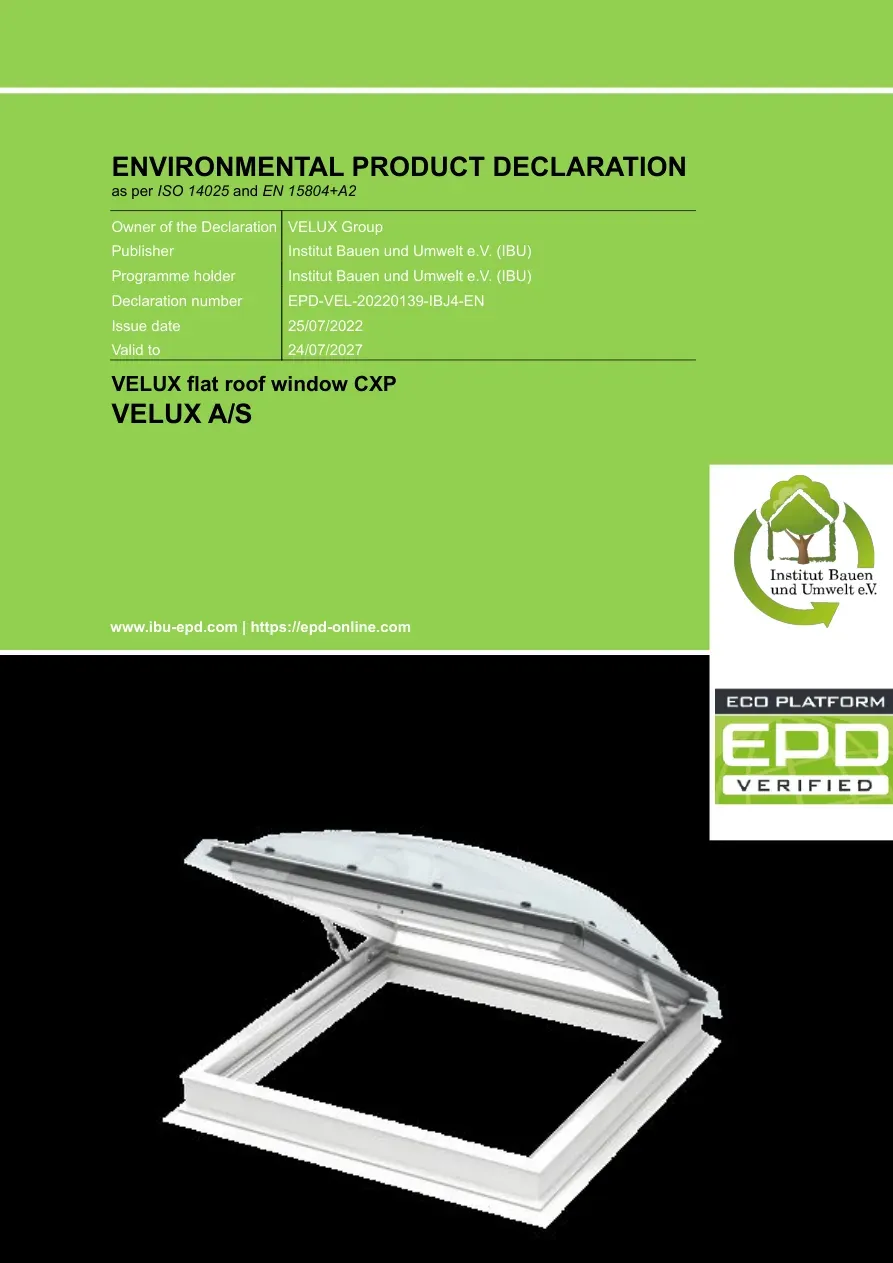
ENVIRONMENTAL PRODUCT DECLARATION as per ISO 14025 and EN 15804+A2Owner of the Declaration VELUX GroupPublisherInstitut Bauen und Umwelt e.V. (IBU)Programme holderInstitut Bauen und Umwelt e.V. (IBU)Declaration numberEPD-VEL-20220139-IBJ4-ENIssue date25/07/2022Valid to24/07/2027VELUX flat roof window CXPVELUX A/Swww.ibu-epd.com | https://epd-online.com
1. General InformationVELUX A/SVELUX flat roof window CXPProgramme holderIBU – Institut Bauen und Umwelt e.V.Hegelplatz 110117 BerlinGermanyOwner of the declarationVELUX GroupÅdalsvej 992970 HørsholmDenmark Declaration numberEPD-VEL-20220139-IBJ4-ENDeclared product / declared unitThe declaration represents 1 piece of a VELUX flat roof window CXP ofthe size 1.20 m x 1.20 m = 1.44 m2This declaration is based on the product category rules:Windows and doors , 01/08/2021 (PCR checked and approved by the SVR)Issue date25/07/2022Valid to24/07/2027Dipl.-Ing. Hans Peters (Chairman of Institut Bauen und Umwelt e.V.)Scope:The declaration covers 100% of VELUX flat roof windows CXP byPartizánske Building Components SK, Slovakia.The owner of the declaration shall be liable for the underlying informationand evidence; the IBU shall not be liable with respect to manufacturerinformation, life cycle assessment data and evidences.The EPD was created according to the specifications of EN 15804+A2. Inthe following, the standard will be simplified as EN 15804.VerificationThe standard EN 15804 serves as the core PCRIndependent verification of the declaration and data according to ISO14025:2011 internally X externallyFlorian Pronold (Managing Director Institut Bauen und Umwelt e.V.)Dr. Eva Schmincke,(Independent verifier)Environmental Product Declaration - VELUX A/S - VELUX flat roof window CXP1
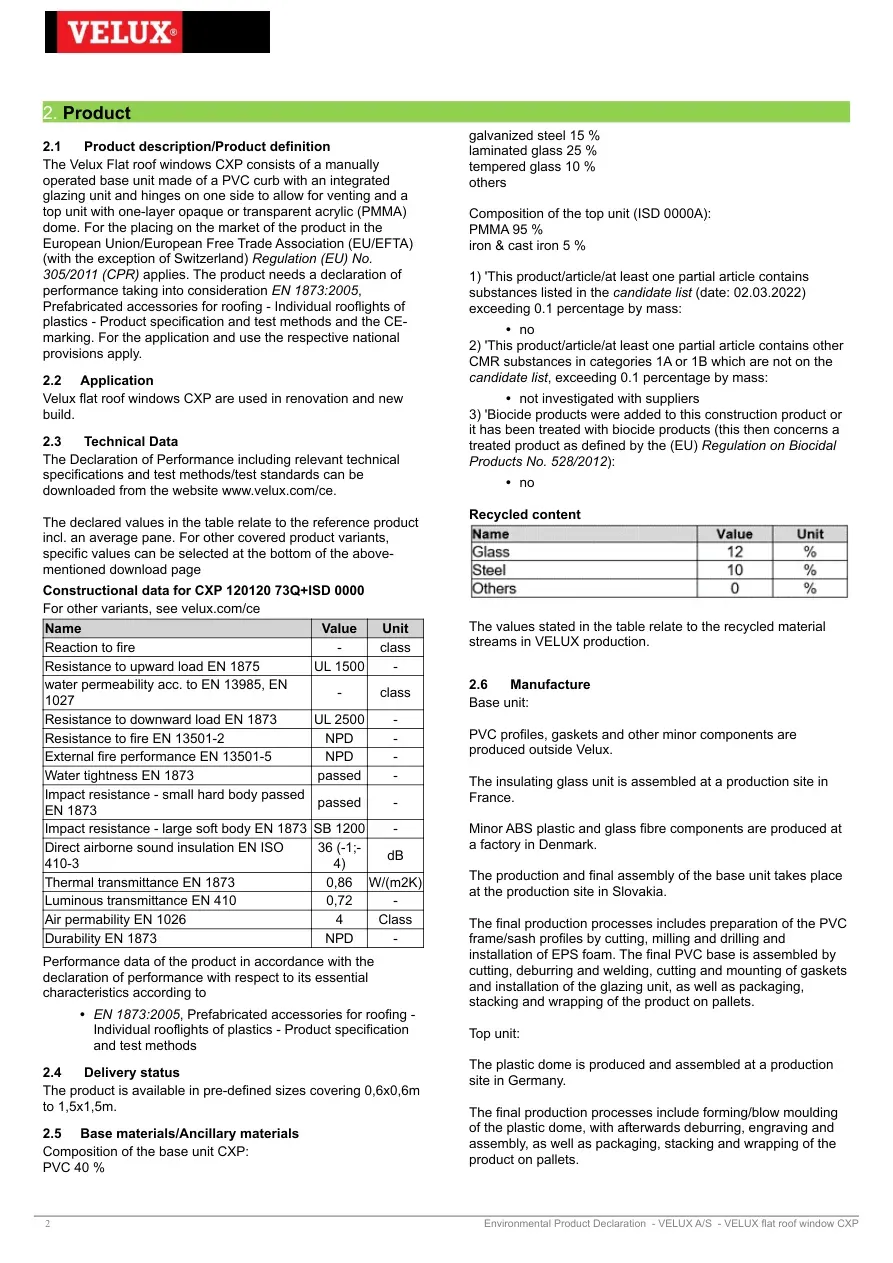
2. Product2.1 Product description/Product definitionThe Velux Flat roof windows CXP consists of a manuallyoperated base unit made of a PVC curb with an integratedglazing unit and hinges on one side to allow for venting and atop unit with one-layer opaque or transparent acrylic (PMMA)dome. For the placing on the market of the product in theEuropean Union/European Free Trade Association (EU/EFTA)(with the exception of Switzerland) Regulation (EU) No.305/2011 (CPR) applies. The product needs a declaration ofperformance taking into consideration EN 1873:2005,Prefabricated accessories for roofing - Individual rooflights ofplastics - Product specification and test methods and the CE-marking. For the application and use the respective nationalprovisions apply.2.2 ApplicationVelux flat roof windows CXP are used in renovation and newbuild.2.3 Technical DataThe Declaration of Performance including relevant technicalspecifications and test methods/test standards can bedownloaded from the website www.velux.com/ce.The declared values in the table relate to the reference productincl. an average pane. For other covered product variants,specific values can be selected at the bottom of the above-mentioned download pageConstructional data for CXP 120120 73Q+ISD 0000For other variants, see velux.com/ceNameValueUnitReaction to fire-classResistance to upward load EN 1875UL 1500-water permeability acc. to EN 13985, EN1027-classResistance to downward load EN 1873UL 2500-Resistance to fire EN 13501-2NPD-External fire performance EN 13501-5NPD-Water tightness EN 1873passed-Impact resistance - small hard body passedEN 1873passed-Impact resistance - large soft body EN 1873 SB 1200-Direct airborne sound insulation EN ISO410-336 (-1;-4)dBThermal transmittance EN 18730,86W/(m2K)Luminous transmittance EN 4100,72-Air permability EN 10264ClassDurability EN 1873NPD-Performance data of the product in accordance with thedeclaration of performance with respect to its essentialcharacteristics according to • EN 1873:2005, Prefabricated accessories for roofing -Individual rooflights of plastics - Product specificationand test methods 2.4 Delivery statusThe product is available in pre-defined sizes covering 0,6x0,6mto 1,5x1,5m.2.5 Base materials/Ancillary materialsComposition of the base unit CXP:PVC 40 %galvanized steel 15 %laminated glass 25 %tempered glass 10 %othersComposition of the top unit (ISD 0000A):PMMA 95 %iron & cast iron 5 %1) 'This product/article/at least one partial article containssubstances listed in the candidate list (date: 02.03.2022)exceeding 0.1 percentage by mass: • no2) 'This product/article/at least one partial article contains otherCMR substances in categories 1A or 1B which are not on thecandidate list, exceeding 0.1 percentage by mass: • not investigated with suppliers3) 'Biocide products were added to this construction product orit has been treated with biocide products (this then concerns atreated product as defined by the (EU) Regulation on BiocidalProducts No. 528/2012): • noRecycled contentThe values stated in the table relate to the recycled materialstreams in VELUX production.2.6 ManufactureBase unit:PVC profiles, gaskets and other minor components areproduced outside Velux.The insulating glass unit is assembled at a production site inFrance.Minor ABS plastic and glass fibre components are produced ata factory in Denmark.The production and final assembly of the base unit takes placeat the production site in Slovakia.The final production processes includes preparation of the PVCframe/sash profiles by cutting, milling and drilling andinstallation of EPS foam. The final PVC base is assembled bycutting, deburring and welding, cutting and mounting of gasketsand installation of the glazing unit, as well as packaging,stacking and wrapping of the product on pallets. Top unit:The plastic dome is produced and assembled at a productionsite in Germany.The final production processes include forming/blow mouldingof the plastic dome, with afterwards deburring, engraving andassembly, as well as packaging, stacking and wrapping of theproduct on pallets. Environmental Product Declaration - VELUX A/S - VELUX flat roof window CXP2
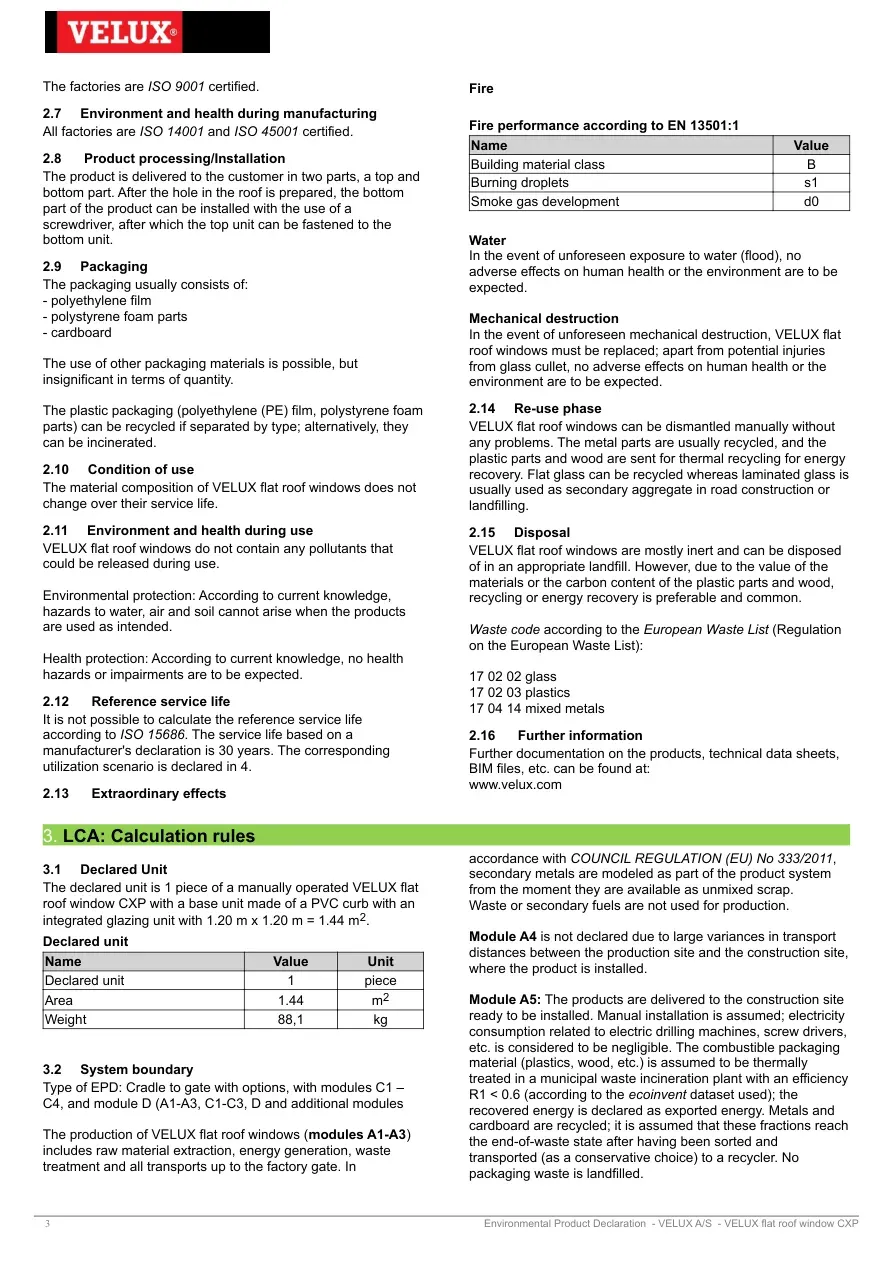
The factories are ISO 9001 certified.2.7 Environment and health during manufacturingAll factories are ISO 14001 and ISO 45001 certified.2.8 Product processing/InstallationThe product is delivered to the customer in two parts, a top andbottom part. After the hole in the roof is prepared, the bottompart of the product can be installed with the use of ascrewdriver, after which the top unit can be fastened to thebottom unit.2.9 PackagingThe packaging usually consists of:- polyethylene film- polystyrene foam parts- cardboardThe use of other packaging materials is possible, butinsignificant in terms of quantity.The plastic packaging (polyethylene (PE) film, polystyrene foamparts) can be recycled if separated by type; alternatively, theycan be incinerated.2.10 Condition of useThe material composition of VELUX flat roof windows does notchange over their service life.2.11 Environment and health during useVELUX flat roof windows do not contain any pollutants thatcould be released during use.Environmental protection: According to current knowledge,hazards to water, air and soil cannot arise when the productsare used as intended. Health protection: According to current knowledge, no healthhazards or impairments are to be expected.2.12 Reference service lifeIt is not possible to calculate the reference service lifeaccording to ISO 15686. The service life based on amanufacturer's declaration is 30 years. The correspondingutilization scenario is declared in 4. 2.13 Extraordinary effectsFireFire performance according to EN 13501:1NameValueBuilding material classBBurning dropletss1Smoke gas developmentd0WaterIn the event of unforeseen exposure to water (flood), noadverse effects on human health or the environment are to beexpected. Mechanical destruction In the event of unforeseen mechanical destruction, VELUX flatroof windows must be replaced; apart from potential injuriesfrom glass cullet, no adverse effects on human health or theenvironment are to be expected.2.14 Re-use phaseVELUX flat roof windows can be dismantled manually withoutany problems. The metal parts are usually recycled, and theplastic parts and wood are sent for thermal recycling for energyrecovery. Flat glass can be recycled whereas laminated glass isusually used as secondary aggregate in road construction orlandfilling.2.15 DisposalVELUX flat roof windows are mostly inert and can be disposedof in an appropriate landfill. However, due to the value of thematerials or the carbon content of the plastic parts and wood,recycling or energy recovery is preferable and common.Waste code according to the European Waste List (Regulationon the European Waste List): 17 02 02 glass17 02 03 plastics17 04 14 mixed metals2.16 Further informationFurther documentation on the products, technical data sheets,BIM files, etc. can be found at:www.velux.com3. LCA: Calculation rules3.1 Declared UnitThe declared unit is 1 piece of a manually operated VELUX flatroof window CXP with a base unit made of a PVC curb with anintegrated glazing unit with 1.20 m x 1.20 m = 1.44 m2.Declared unitNameValueUnitDeclared unit1pieceArea1.44m2Weight88,1kg 3.2 System boundaryType of EPD: Cradle to gate with options, with modules C1 –C4, and module D (A1-A3, C1-C3, D and additional modulesThe production of VELUX flat roof windows (modules A1-A3)includes raw material extraction, energy generation, wastetreatment and all transports up to the factory gate. Inaccordance with COUNCIL REGULATION (EU) No 333/2011,secondary metals are modeled as part of the product systemfrom the moment they are available as unmixed scrap.Waste or secondary fuels are not used for production.Module A4 is not declared due to large variances in transportdistances between the production site and the construction site,where the product is installed.Module A5: The products are delivered to the construction siteready to be installed. Manual installation is assumed; electricityconsumption related to electric drilling machines, screw drivers,etc. is considered to be negligible. The combustible packagingmaterial (plastics, wood, etc.) is assumed to be thermallytreated in a municipal waste incineration plant with an efficiencyR1 < 0.6 (according to the ecoinvent dataset used); therecovered energy is declared as exported energy. Metals andcardboard are recycled; it is assumed that these fractions reachthe end-of-waste state after having been sorted andtransported (as a conservative choice) to a recycler. Nopackaging waste is landfilled.Environmental Product Declaration - VELUX A/S - VELUX flat roof window CXP3
Modules B1 to B7 are not relevant for the product underconsideration or no significant environmental impacts occur.Module C1 includes manual dismantling, with no significantenvironmental impact.Module C2 comprises the transport of the dismantled VELUXflat roof window to a sorting plant and then to a wasteincineration plant for the thermally treated plastic fraction.Modules C3/C4: given the complexity of the inventoriedproducts, a mixed end-of-life scenario is modelled, allowing thedifferent materials to follow their most likely path.As a rule of thumb, metals are recycled and plastics areincinerated (also due to the very limited data availability ofplastics recycling and its benefits); coated and uncoated flatglass is assumed to be recycled whereas laminated glass isassumed to be landfilled due to very limited recycling potential.Metals and flat glass recycled; it is assumed that these fractionsreach the end-of-waste state after having been sorted andtransported to a recycler; laminated glass is landfilled. Thecombustible material (plastics, etc.) is assumed to be thermallytreated in a municipal waste incineration plant.Module D includes the benefits and burdens associated withrecycling metals beyond the system boundary, resulting fromthe treatment of recycled materials from the point of end-of-waste to the point of substitution (as loads) and substitution ofprimary resources (as benefits).It also includes the benefits and burdens associated withenergy recovery from plastic waste in a municipal wasteincineration plant, as modeled in Module C3.In Module D, only net flows of metals leaving the productsystem are considered.3.3 Estimates and assumptionsNo further assumptions and estimates relevant to the result hadto be made beyond the points made in this chapter 3 and inchapter 4.3.4 Cut-off criteriaNo data available from the company survey was neglected.These include, among other things, material use, energydemand (heat, electricity), packaging materials of raw materials(insofar as they are generated as waste) and productpackaging, consumables in production, waste treatment andthe transport of all inputs and outputs.With this approach, mass and energy flows below 1 % werealso accounted for. No processes were neglected that wouldhave been known to the project managers and would havecontributed significantly to the indicators of the impactassessment.3.5 Background dataEcoinvent 3.8 (2021) is used as the background database.3.6 Data qualityThe foreground data are based on extensive and detailed datacollection at the production site. The foreground data could befully linked with corresponding data records from thebackground database ecoinvent 3.8.The background data was updated in 2021. Thus, the quality ofthe foreground and background data can be rated as verygood.3.7 Period under reviewThe LCA data represents the production conditions for the year2021.3.8 Geographic RepresentativenessLand or region, in which the declared product system ismanufactured, used or handled at the end of the product´slifespan: Europe3.9 AllocationNo co-products are generated during the production of theVELUX products. Sorted production scrap of the differentmetals, notably aluminium, is considered a secondary materialwith no economic value (so no burdens allocated) andconsidered in the quantification of net flows leaving the productsystem. This approach is chosen to ensure a coherentquantification of net flows entering module D.No processes were modelled as part of the foreground modelthat would have required an allocation of multi-input processes.Background datasets on municipal waste incineration plantswere taken from ecoinvent without any modification.Allocation of reuse, recycling and recovery was avoided by thecut-off approach in the foreground model in line with DIN EN15804.3.10 ComparabilityBasically, a comparison or an evaluation of EPD data is onlypossible if all the data sets to be compared were createdaccording to EN 15804 and the building context, respectivelythe product-specific characteristics of performance, are takeninto account. 4. LCA: Scenarios and additional technical informationCharacteristic product properties of biogenic carbonInformation on describing the biogenic carbon content atfactury gateNameValue UnitBiogenic carbon content in product0.255 kgCBiogenic carbon content in accompanyingpackaging1.94kgCNote: 1 kg of biogenic carbon is equivalent to 44/12 kg of CO2.Module A5The products are delivered to the construction site ready to beinstalled. Manual installation is assumed, and electricityconsumption related to electric drilling machines, screw drivers,etc. is considered to be negligible.The combustible packaging material (plastics, wood, etc.) isassumed to be transported 50 km with a lorry 16-32 metrictons, EURO6 to an incineration plant with an efficiency R1 < 0.6(according to the ecoinvent dataset used); the recoveredenergy is declared as exported energy; for its quantification anefficiency of 25.6 % is assumed for the production of heat and13.0 % for the production of electricity (always referring to thelower heating value of the waste).Metals and cardboard are recycled; it is assumed that thesefractions reach the end-of-waste state after having been sortedand transported (as a conservative choice) to a recycler overEnvironmental Product Declaration - VELUX A/S - VELUX flat roof window CXP4
150 km with a lorry 16-32 metric tons, EURO6.No packaging waste is landfilled.The use of multi-way pallets is not taken into account aspackaging material. Reference service lifeNameValueUnitReference service lifeaccording tomanufacturer's declaration30aDeclared productproperties (at the gate) andfinishesThe product has passedinternal quality controls andcomplies with EN 1873 for CEmarking-Design applicationparameters (if instructed bythe manufacturer),including the references tothe appropriate practicesand application codesInstallation according toassembly instructions andstate of the art.-An assumed quality ofwork, when installed inaccordance with themanufacturer’s instructionsCarried out in accordancewith the manufacturer'sinstructions.-Outdoor environment, (foroutdoor applications), e.g.weathering, pollutants, UVand wind exposure,building orientation,shading, temperatureThe declared products areintended for installationoutside the building: They aretherefore designed towithstand outdoor conditionsthroughout their service life.-Indoor environment (forindoor applications), e.g.temperature, moisture,chemical exposureThe declared products arenot intended for installationinside a building.-Usage conditions, e.g.frequency of use,mechanical exposureStandard use in any type ofbuilding, i.e. opening/closingas often as necessary.-Maintenance e.g. requiredfrequency, type and qualityand replacement ofcomponentsThe declared products aredesigned for a reference lifeof 30 years. They aremaintained by cleaning waterat the discretion of thebuilding occupants.-Module B1The products are assumed to have no direct emissions duringthe use phase. The indicator values of Module B1 are thus 0.For biogenic carbon storage, see table above.Module B2For manually operated flat roof windows, no impacts related tomaintenance are inventoried in module B2. Annual cleaningwith water (e.g., using 1 l/m2 of tap water per annual cleaning)is neglected.Module B6Manually operated flat roof windows do not consumeoperational energy.Module C1Manual de-installation is assumed, electricity consumptionrelated to electric screw drivers, etc. is considered to benegligible. Thus, no environmental impacts are declared inmodule C1.Module C2Given the complexity of the inventoried products, a mixed end-of-life scenario is modelled, allowing the different materials tofollow their most likely path.It should also be noted that the deconstruction and wastetreatment scenario can vary a lot, depending on the actualsituation. Thus, a generic end-of-life scenario is assumed.As a rule of thumb, metals are recycled, plastics are incinerated(also due to the very limited availability on plastics recyclingand its benefits); coated and uncoated flat glass is assumed tobe recycled whereas laminated glass is assumed to belandfilled due to very limited recycling potential.The combustible material (mainly plastics) is assumed to betransported 50 km with a lorry 16-32 metric tons, EURO6 to anincineration plant.Metals and flat glass recycled; it is assumed that these fractionsreach the end-of-waste state after having been sorted andtransported to a recycler over 150 km with a lorry 16-32 metrictons, EURO6.Laminated glass is landfilled, including a transport of 30 km witha lorry 16-32 metric tons, EURO6.Module C3A consumption of 0.03 kWh/kg of electricity for shredding andsorting and 0.437 MJ/kg of diesel fuel for internal logistics aretaken into account to disassemble the product. The recoveredmaterial leaves the product system as 'materials for recycling'.The net amounts of the metals leaving the product system areconsidered as 'use of secondary material' in Module D.Module C4As stated above, it is assumed that 100 % of the plastic partsand the wooden parts are treated in a waste incineration plantwith an efficiency R1 < 0.6 (according to the ecoinvent datasetused); 25.57 % of the lower heating value of the plastic partsare recovered as heat and 13.0 % as electricity. Recoveredenergy is reported as 'exported energy' and considered inModule D.Some of the material, notably laminated flat glass is assumedto be landfilled.Module DModule D contains the benefits and loads beyond the systemboundary related to the recycling of metals, which result fromthe treatment of recycled materials from the point of end-of-waste status to the point of substitution (as loads) and thesubstitution of primary resources (as benefits).Furthermore, it includes the benefits of raw material substitutionof the recycling of flat glass, with the exception of laminatedglass, which cannot be used for the production of glass again.Recovered flat glass is assumed to have reached the end-of-waste state as sorted glass cullet; glass cullet is assumed toreplace virgin raw material for glass production – impacts onthe energy required to remelt recycled glass as compared tovirgin glass production are neglected due to a lack of data.It also includes the benefits and loads related to the energyrecovery from plastic wastes in a MWIP as modelled inModules A3, A5 and C3.Due to a lack of data for plastics from de-construction activities,the substitution potential of recycled plastics is not taken intoaccount.Only net flows leaving the product system are considered inmodule D.Environmental Product Declaration - VELUX A/S - VELUX flat roof window CXP5
5. LCA: ResultsDisclaimer:EP-freshwater: This indicator has been calculated as 'kg P eq' as required in the characterization model (EUTREND model, Struijs etal., 2009b, as implemented in ReCiPe; http://eplca.jrc.ec.europa.eu/LCDN/developerEF.xhtml)DESCRIPTION OF THE SYSTEM BOUNDARY (X = INCLUDED IN LCA; MND = MODULE OR INDICATOR NOT DECLARED; MNR= MODULE NOT RELEVANT)Product stageConstructionprocess stageUse stageEnd of life stageBenefits andloads beyondthe systemboundariesA1A2A3A4A5B1B2B3B4B5B6B7C1C2C3C4DXXXMNDXXXMNRMNRMNRXMNDXXXXXRESULTS OF THE LCA - ENVIRONMENTAL IMPACT according to EN 15804+A2: 1 piece VELUX flat roof window CXP,manually operated, 1.20 m x 1.20 m = 1.44 m2ParameterUnitA1-A3A5B1B2B6C1C2C3C4DGWP = Global warming potential; ODP = Depletion potential of the stratospheric ozone layer; AP = Acidification potential of land and water; EP =Eutrophication potential; POCP = Formation potential of tropospheric ozone photochemical oxidants; ADPE = Abiotic depletion potential for non-fossilresources; ADPF = Abiotic depletion potential for fossil resources; WDP = Water (user) deprivation potential)RESULTS OF THE LCA - INDICATORS TO DESCRIBE RESOURCE USE according to EN 15804+A2: 1 piece VELUX flat roofwindow CXP, manually operated, 1.20 m x 1.20 m = 1.44 m2ParameterUnitA1-A3A5B1B2B6C1C2C3C4DPERE = Use of renewable primary energy excluding renewable primary energy resources used as raw materials; PERM = Use of renewable primaryenergy resources used as raw materials; PERT = Total use of renewable primary energy resources; PENRE = Use of non-renewable primary energyexcluding non-renewable primary energy resources used as raw materials; PENRM = Use of non-renewable primary energy resources used as rawmaterials; PENRT = Total use of non-renewable primary energy resources; SM = Use of secondary material; RSF = Use of renewable secondary fuels;NRSF = Use of non-renewable secondary fuels; FW = Use of net fresh waterRESULTS OF THE LCA – WASTE CATEGORIES AND OUTPUT FLOWS according to EN 15804+A2:1 piece VELUX flat roof window CXP, manually operated, 1.20 m x 1.20 m = 1.44 m2ParameterUnitA1-A3A5B1B2B6C1C2C3C4DEnvironmental Product Declaration - VELUX A/S - VELUX flat roof window CXPRaw materialsupplyTransportManufacturingTransport from thegate to the siteAssemblyUseMaintenanceRepairReplacementRefurbishmentOperational energyuseOperational wateruseDe-constructiondemolitionTransportWaste processingDisposalReuse-Recovery-Recycling-potentialGWP-totalkg CO2 eq2.6E+028.98E+0000007.02E-012.76E+009.64E+01-5.9E+01GWP-fossilkg CO2 eq2.68E+021.88E+0000007.02E-011.82E+009.63E+01-5.89E+01GWP-biogenickg CO2 eq-8.03E+007.1E+00000009.36E-0100GWP-luluckg CO2 eq2.57E-018.44E-0500002.86E-042.03E-033.26E-02-1.01E-01ODPkg CFC11 eq5.78E-054.78E-0800001.65E-071.12E-071.11E-05-3.65E-06APmol H+ eq1.19E+001.31E-0300003.98E-036.96E-031.22E-01-2.02E-01EP-freshwaterkg P eq8.19E-031.61E-0600005.16E-062.36E-049.65E-04-3.93E-03EP-marinekg N eq2.25E-014.91E-0400001.43E-032.23E-032.71E-02-3.36E-02EP-terrestrialmol N eq2.42E+005.43E-0300001.57E-022.53E-022.99E-01-3.83E-01POCPkg NMVOCeq7.93E-011.53E-0300004.5E-036.75E-038.02E-02-1.19E-01ADPEkg Sb eq5.38E+026.99E-0700002.35E-063.17E-062.58E-043.73E-05ADPFMJ3.7E+033.13E+0000001.08E+012.52E+012.49E+02-7.47E+02WDPm3 world eqdeprived1.01E+021.27E-0200003.55E-026.26E-021.84E+01-4.28E+00PEREMJ1.97E+024.74E-0200001.53E-013.18E+002.79E+01-7.01E+01PERMMJ9.36E+01-8.16E+0100000-1.21E+0100PERTMJ2.91E+02-8.15E+0100001.53E-01-8.88E+002.79E+01-7.01E+01PENREMJ3.45E+032.88E+0100001.08E+012.01E-051.15E+03-7.54E+02PENRMMJ9.29E+02-2.57E+01000000-9.03E+020PENRTMJ4.38E+033.13E+0000001.08E+012.01E-052.49E+02-7.54E+02SMkg2.25E+0100000000-6.77E+00RSFMJ0000000000NRSFMJ0000000000FWm32.41E+006.25E-0400001.18E-036.01E-034.81E-01-2.28E-01HWDkg2.37E-028.25E-0600002.76E-052.01E-054.23E-041.84E-03NHWDkg5.83E+012.24E-0100007.24E-011.02E-013.79E+01-9.41E+006
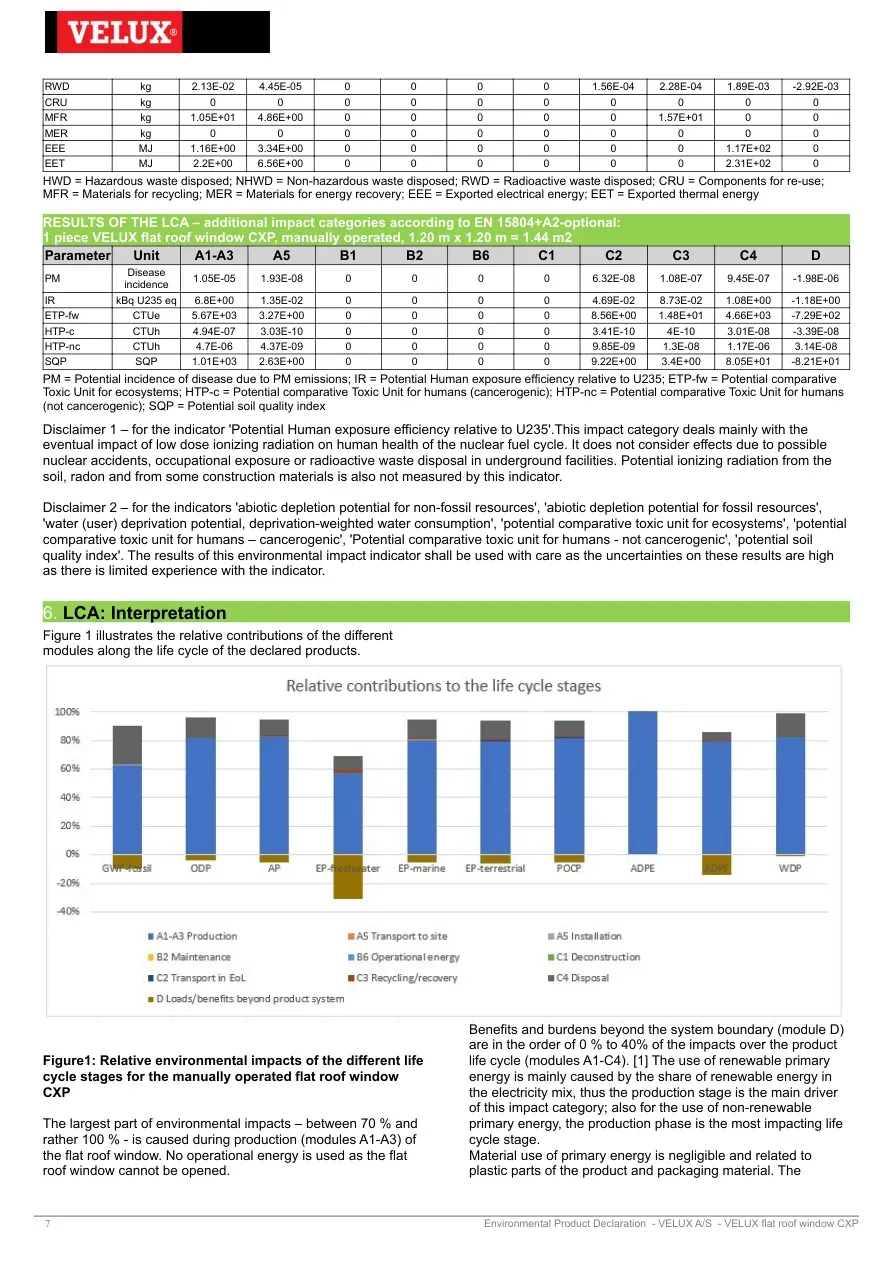
HWD = Hazardous waste disposed; NHWD = Non-hazardous waste disposed; RWD = Radioactive waste disposed; CRU = Components for re-use;MFR = Materials for recycling; MER = Materials for energy recovery; EEE = Exported electrical energy; EET = Exported thermal energyRESULTS OF THE LCA – additional impact categories according to EN 15804+A2-optional:1 piece VELUX flat roof window CXP, manually operated, 1.20 m x 1.20 m = 1.44 m2ParameterUnitA1-A3A5B1B2B6C1C2C3C4DPM = Potential incidence of disease due to PM emissions; IR = Potential Human exposure efficiency relative to U235; ETP-fw = Potential comparativeToxic Unit for ecosystems; HTP-c = Potential comparative Toxic Unit for humans (cancerogenic); HTP-nc = Potential comparative Toxic Unit for humans(not cancerogenic); SQP = Potential soil quality indexDisclaimer 1 – for the indicator 'Potential Human exposure efficiency relative to U235'.This impact category deals mainly with theeventual impact of low dose ionizing radiation on human health of the nuclear fuel cycle. It does not consider effects due to possiblenuclear accidents, occupational exposure or radioactive waste disposal in underground facilities. Potential ionizing radiation from thesoil, radon and from some construction materials is also not measured by this indicator.Disclaimer 2 – for the indicators 'abiotic depletion potential for non-fossil resources', 'abiotic depletion potential for fossil resources','water (user) deprivation potential, deprivation-weighted water consumption', 'potential comparative toxic unit for ecosystems', 'potentialcomparative toxic unit for humans – cancerogenic', 'Potential comparative toxic unit for humans - not cancerogenic', 'potential soilquality index'. The results of this environmental impact indicator shall be used with care as the uncertainties on these results are highas there is limited experience with the indicator.6. LCA: InterpretationFigure 1 illustrates the relative contributions of the differentmodules along the life cycle of the declared products.Figure1: Relative environmental impacts of the different lifecycle stages for the manually operated flat roof windowCXPThe largest part of environmental impacts – between 70 % andrather 100 % - is caused during production (modules A1-A3) ofthe flat roof window. No operational energy is used as the flatroof window cannot be opened.Benefits and burdens beyond the system boundary (module D)are in the order of 0 % to 40% of the impacts over the productlife cycle (modules A1-C4). [1] The use of renewable primaryenergy is mainly caused by the share of renewable energy inthe electricity mix, thus the production stage is the main driverof this impact category; also for the use of non-renewableprimary energy, the production phase is the most impacting lifecycle stage.Material use of primary energy is negligible and related toplastic parts of the product and packaging material. TheEnvironmental Product Declaration - VELUX A/S - VELUX flat roof window CXPRWDkg2.13E-024.45E-0500001.56E-042.28E-041.89E-03-2.92E-03CRUkg0000000000MFRkg1.05E+014.86E+00000001.57E+0100MERkg0000000000EEEMJ1.16E+003.34E+000000001.17E+020EETMJ2.2E+006.56E+000000002.31E+020PMDiseaseincidence1.05E-051.93E-0800006.32E-081.08E-079.45E-07-1.98E-06IRkBq U235 eq6.8E+001.35E-0200004.69E-028.73E-021.08E+00-1.18E+00ETP-fwCTUe5.67E+033.27E+0000008.56E+001.48E+014.66E+03-7.29E+02HTP-cCTUh4.94E-073.03E-1000003.41E-104E-103.01E-08-3.39E-08HTP-ncCTUh4.7E-064.37E-0900009.85E-091.3E-081.17E-063.14E-08SQPSQP1.01E+032.63E+0000009.22E+003.4E+008.05E+01-8.21E+017
material use of primary energy is transferred to its energy usewhen the materials containing primary energy are incineratedwith energy recovery.Non-hazardous waste as the quantitatively most relevant wasteflows is mainly caused during the production of the glass andduring disposal of the product; hazardous and radio-activewastes are mainly caused by the European electricity mix.[1] Benefits resulting from the recycling of plastics as well asfrom the recycling of the electronic parts are disregarded due tothe lack of data on the recycling processes and related to thedetailed composition of the electronic parts.7. Requisite evidence8.1 FormaldehydeNot tested based on applicable product standard. 7.2 MDINot tested based on applicable product standard. 7.3Checking of pre-treatment of substances used accordingto AltholzVONot applicable; not tested based on applicable productstandard. 7.4. Fire gas toxicityNot tested based on applicable product standard. 7.5 VOCemissionsNot tested based on applicable product standard.8. ReferencesProduct category rules of IBUIBU (2021)IBU (2021): General Instructions for the EPD Programme of theInstitut Bauen & Umwelt e.V. (General Instructions for the IBUEPD Programme). Version 2.0, Institut Bauen & Umwelt, Berlin IBU (2017)IBU (2017): PCR Teil A: PCR Part A: Calculation rules for thelife cycle assessment and requirements for the project report.Version 1.8., Institut Bauen & Umwelt, Berlin.IBU (2021)IBU (2021):PCR Part B: Requirements on the EPD for windowsand doors. Version 2021/01, Institut Bauen & Umwelt, Berlin.Standards and legal documentsEN 15804DIN EN 15804+A2:2019, Sustainability of construction works -Environmental product declarations - Core rules for the productcategory construction products.ISO 14025DIN EN ISO 14025:2006-07, Environmental labels anddeclarations - Type III Environmental declarations - Principlesand procedures.ISO 14044DIN EN ISO 14044:2006-07, Environmental management - Lifecycle assessment - Requirements and guidance (ISO14044:2006); German and English versions EN ISO14044:2006.ISO 9001DIN EN ISO 9001:2015, Quality management systems -Requirements. ISO 14001DIN EN ISO 14001:2015: Environmental managementsystems - Requirements with guidance for use.ISO 45001ISO 45001:2018-03, Occupational health and safetymanagement systems - Requirements with guidance for use.EN 1873DIN EN 1873:2005, Prefabricated accessories for roofing -Individual rooflights of plastics - Product specification and testmethods. EN 16485DIN EN 16485:2014-07, Round and sawn timber -Environmental Product Declarations - Product category rulesfor wood and wood-based products for use in construction;German version EN 16485:2014.ECHA-ListThe Candidate List of substances of very high concern,available via https://echa.europa.eu/nl/-/four-newsubstances-added-to-the-candidate-list.Regulation on biocidal productsREGULATION (EU) No 528/2012 OF THE EUROPEANPARLIAMENT AND OF THE COUNCIL of 22 May 2012concerning the making available on the market and use ofbiocidal products.Regulation (EU) Nr. 305/2011(CPR)REGULATION (EU) No 305/2011 OF THE EUROPEANPARLIAMENT AND OF THE COUNCIL of 9 March 2011 layingdown harmonised conditions for the marketing of constructionproducts and repealing Council Directive 89/106/EEC.COUNCIL REGULATION (EU) No 333/2011COUNCIL REGULATION (EU) No 333/2011 of 31 March 2011establishing criteria determining when certain types of scrapmetal cease to be waste under Directive 2008/98/EC of theEuropean Parliament and of the Council.European Waste List (Waste index)http://www.gesetze-im-internet.de/avv/anlage.htm Additional referencesWeidema et al. (2013)Weidema, B., C. Bauer, R. Hischier, C. Mutel, T. Nemecek, J.Reinhard, C.O. Vadenbo, G. Wernet (2013): Overview andmethodology, Data quality guideline for the ecoinvent databaseversion 3. ecoinvent report no. 1 (v3), St. Gallen, Schweiz.ecoinvent 3.8ecoinvent 3.8, LCA database, 12/2021. Ecoinvent centre,Zürich. Environmental Product Declaration - VELUX A/S - VELUX flat roof window CXP8
PublisherInstitut Bauen und Umwelt e.V. Hegelplatz 1 10117 Berlin Germany+49 (0)30 3087748- 0 info@ibu-epd.com www.ibu-epd.comProgramme holderInstitut Bauen und Umwelt e.V. Hegelplatz 1 10117 Berlin Germany+49 (0)30 3087748- 0 info@ibu-epd.com www.ibu-epd.comAuthor of the Life Cycle AssessmentDr. Frank Werner - Umwelt & EntwicklungKammelenbergstrasse 309011 St. GallenSwitzerland+ 41 (0)44 241 39 06frank@frankwerner.chhttp://www.frankwerner.ch/Owner of the DeclarationVELUX GroupÅdalsvej 992970 HørsholmDenmark+4545164726jakob.roerbech@velux.comwww.velux.comEnvironmental Product Declaration - VELUX A/S - VELUX flat roof window CXP9
